First Apartment Checklist: What to Buy Before Move-In and What Can Wait

The week before you move into your first apartment, every checklist online seems to assume a different life. One tells you to buy a stand mixer. Another expects you to already own a vacuum, a full set of pots, and a couch that fits through the door.
Almost none of it has to happen before move-in day. What you actually need is a short list that keeps you clean, fed, and able to sleep on the first night, plus a plan for the rest. Everything else can arrive once you've lived in the apartment long enough to know what you're missing.
This first apartment checklist follows that order. The printable version is one page you can print or copy into your phone, and it covers what to confirm with the property manager before you spend anything, what to pack for night one, what's worth buying in the first week, what to measure before ordering furniture, and how to cover the essentials on a limited budget. If you haven't signed a lease yet, start with what to look for when renting an apartment, then come back to this list.
The checklist, in three tiers
Print this page or copy the three tiers into a note on your phone. Most first apartment essentials land in one of them. Tier 3 isn't a list of things you'll never buy, just the things worth buying when a real need shows up.
Tier 1: Pack for the first night. These should arrive with you, not on the truck.
Tier 2: Buy in the first week.
Tier 3: Wait until you've lived there.
Confirm these things before you buy anything
Your lease and your property manager can answer most of the questions that decide what you should buy. Ask before move-in day, by email, so the answers stay in writing. A short message with a numbered list gets a faster reply than a phone call.
-
Which appliances are included, and do they work? Ask about the fridge, stove, oven, microwave, dishwasher, in-unit washer and dryer, and air conditioning. If laundry is in the basement instead, you can skip buying a drying rack and a second hamper.
-
What's already installed? Shower curtain rod, blinds, light fixtures and bulbs, closet shelving, towel bars, and the mailbox key. These are the small purchases that add up in the first week.
-
Which utilities are in your name? Water and trash are often bundled into rent while electricity and gas are not. Ask which internet providers serve the building and whether installation requires someone to let a technician in.
-
Is renter's insurance required? Many leases require it, and some name a minimum coverage. Get the requirement in writing, because it belongs in your monthly budget.
-
How does move-in day work? Elevator reservations, loading zone rules, allowed hours, and any move-in fee. A building that only allows moves between 9 a.m. and 5 p.m. on weekdays will change your plans.
-
What can go on the walls? Nails, picture hooks, wall anchors, a mounted TV, paint, and shelves. Ask before you buy hardware or a heavy mirror you can't hang.
-
How do I document the unit's condition? Ask what the building wants: photos, a signed checklist, or a deadline for reporting damage. Take your own dated photos of every room before the boxes arrive, because that record is what protects your deposit.
-
Is anything left behind? Sometimes the previous tenant leaves a shower curtain, a bookshelf, or cleaning supplies. Ask whether those stay and whether you're responsible for removing anything.
Pack the first-night box so you can find it at midnight
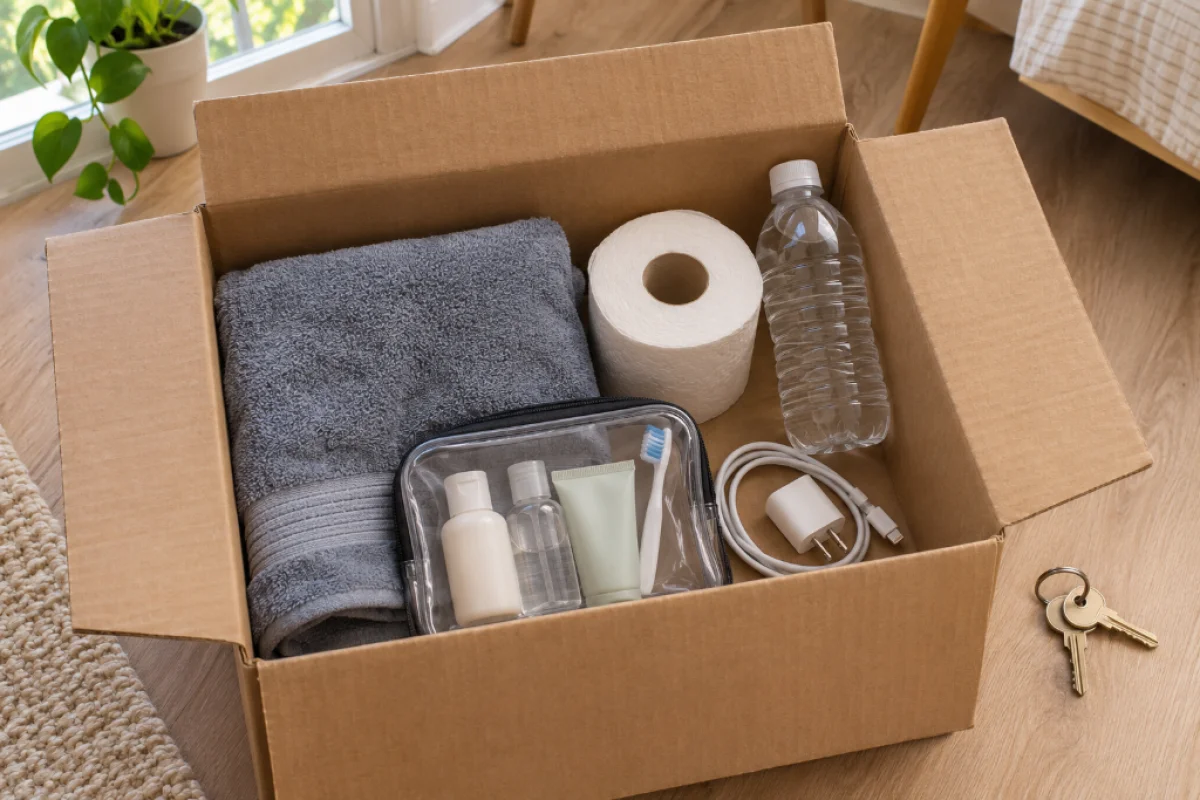
Put tier 1 in one box, write "FIRST NIGHT" on all four sides, and keep it with you rather than loading it into the truck. If you're moving yourself, load it last. If you're flying or taking a bus, it travels as your luggage.
Three items get forgotten most often: toilet paper, a shower curtain, and a way to make coffee. None of them are expensive, and all of them are miserable to discover missing at 11 p.m. in a new neighborhood where you don't yet know what's open.
Pack the box as if you'll be too tired to unpack anything else. Sheets you can put on the bed in two minutes, a charger you can reach without moving furniture, a lamp that works even if the overhead fixture has no bulb. If you're moving with a roommate, pack two of everything you'd both reach for, or agree on one box each so nobody's toothbrush is at the bottom of a stack.
Measure before you order furniture
Furniture bought before you measure is the most common first-apartment spending mistake. A tape measure, a notebook, and ten minutes in the empty unit prevent most of it.
Start with the path, not the room. A sofa has to fit through the building entrance, the hallway, every doorway on the way, any stairwell turns, and the elevator. Interior doors are usually about 30 to 32 inches wide and the entry door closer to 36, but old buildings vary enough that you should measure the narrowest point yourself, including the height.
Then measure the room and the fixed features that eat into it: radiators, baseboard heaters, window sills, closet doors that swing out, and where the outlets are. Sketch the floor plan on paper and write the numbers on it. Note the window widths and heights if you plan to buy curtains, and ask again whether blinds come with the unit.
A few measurements worth having on your phone before you shop online:
-
Elevator interior width, depth, and door height
-
Stairwell width and the landing at each turn
-
The gap beside the fridge or in the laundry closet, if you're buying appliances
-
Ceiling height, for tall shelves and curtains
-
The building's delivery windows
Then use painter's tape to mark the footprint of anything large on the floor and leave it there for a day. A dresser that looked reasonable online can eat the only walkway in a bedroom, and tape shows you that before the delivery fee does. On the mattress, measure the route, not just the bedroom. A mattress in a box goes around tight corners that a spring mattress and box spring won't.
Cover the essentials on a limited budget
Set a total before you shop, and count move-in costs in it: first month's rent, security deposit, utility deposits or connection fees, renter's insurance, the moving truck, and everything on this list. Our guide to how much apartment you can afford works through the monthly side of the math. The move-in side is the part that catches first-time renters, because it lands in one month instead of spreading across twelve.
Once you have a number, these five habits stretch it.
Borrow before you buy. A drill, a tape measure, a hand truck, a vacuum, a ladder, and a bucket are used a handful of times in a decade. Ask family, friends, and neighbors, or post a request in a local buy-nothing group. Some public libraries lend tools and kitchen equipment. A borrowed hand truck saves a rental fee and a sore back.
Buy wood secondhand and soft goods new. Thrift stores, estate sales, and marketplace listings are full of solid wood dressers, bookshelves, and tables that outlast new particleboard at the same price. Check the joints, open and close every drawer, and look underneath. Skip used mattresses and any upholstered piece you can't inspect closely for stains, smells, or pests.
Buy one of each. One knife, one cutting board, one pan, four plates, two mugs. Sets cost more and fill cabinets you may not have. You can add a second pan when you actually cook two things at once.
Shop your building first. If there's a laundry room, you don't need a drying rack yet. If there's a gym, skip the weights. If the unit has closet shelving, you may not need the storage bins on tier 3 at all.
Keep a two-week list. When you reach for something you don't own, write it down instead of ordering it. Whatever you keep reaching for is a real need. Everything else was a good idea in a store.
Why waiting is part of the plan
Waiting isn't about doing without. It's about getting information before you spend. The first two weeks in an apartment tell you things no listing or tour can: where the afternoon light lands, whether a desk actually fits beside the bed, whether you cook at home or order in, how much storage you really have, and which sounds come through the wall at night.
You might plan a desk under the bedroom window and then find the only outlet is across the room. You might buy a rug before discovering the front door drags across that spot. You might stock a kitchen for the meals you cooked at your parents' house and then work late four nights a week. None of those mistakes are catastrophic, but each one costs money you'd rather keep.
The same logic applies to decor. It's the cheapest part of furnishing an apartment to add later and the least important to have on day one. A lamp, a plant, and something on the wall can wait until you know where they belong.
Two exceptions are worth buying immediately: curtains or blinds for the bedroom if the unit has none, and a bath mat. Privacy and a floor that isn't slippery matter on night one.
Still looking for the apartment itself
If you've read this far and don't have keys yet, the checklist works in reverse. It tells you what to ask about during a tour: whether blinds are included, where the laundry is, what the move-in rules are, and which walls you're allowed to hang something on. Those answers change what you'll need to buy.
When you're ready to start looking, browse apartments by city to see listings, addresses, and contact details for apartment communities across the U.S. Find a building that fits your budget first. Then print this list, pack the first-night box, and measure the doorway before you order the couch.
More to Read:

Previous Posts: